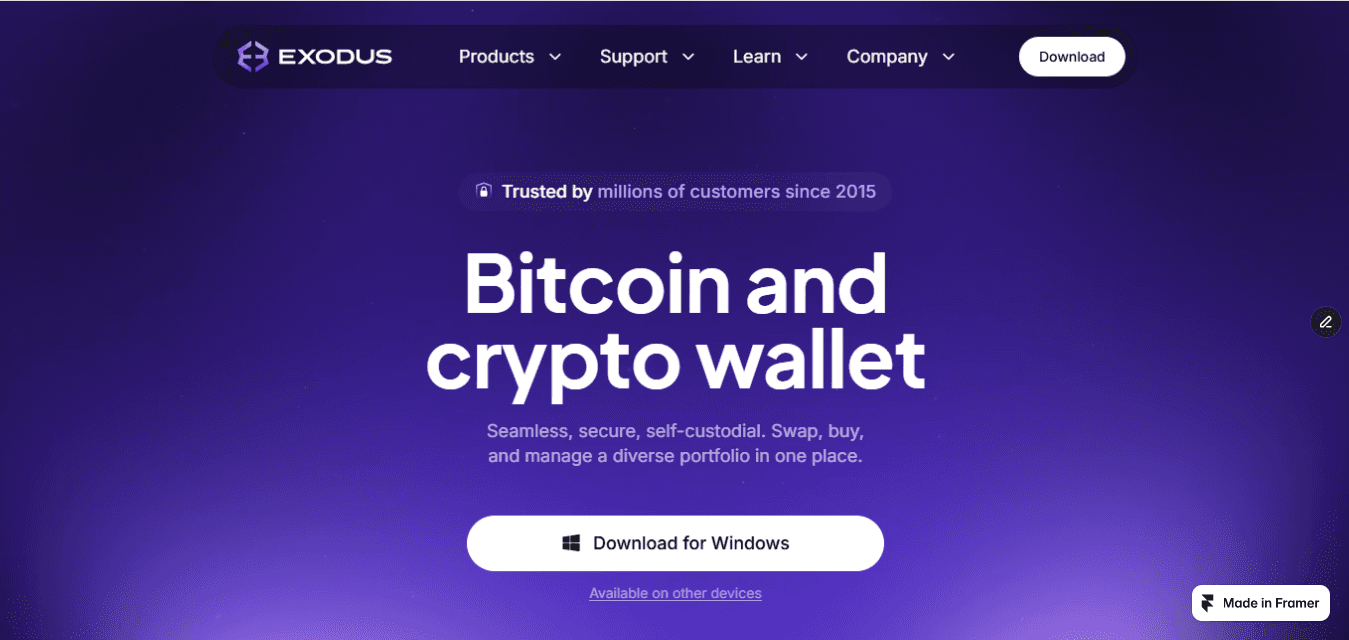
Exodus Web3 Wallet — A Practical Guide for Everyday Crypto Users
Exodus is a user-focused Web3 wallet designed to make cryptocurrency and blockchain interactions approachable without sacrificing control. It balances a friendly visual interface with powerful features that support thousands of assets, on-ramps and off-ramps, dApp connectivity, and integrated swaps. For people new to self-custody as well as experienced traders who value simplicity, Exodus aims to remove technical friction while keeping private keys local to your device.
Core features at a glance
- Multi-asset support: Exodus supports a wide range of coins and tokens across multiple blockchains, including major layer-1 networks and many popular layer-2 solutions. This makes it easy to hold, send, and receive diverse portfolios in one place.
- Built-in exchange and swaps: The wallet offers on-device swapping and portfolio rebalancing via integrated liquidity providers, so users can swap tokens without leaving the interface.
- Web3 dApp connectivity: With WalletConnect support and a browser extension, Exodus can interact with decentralized applications for DeFi, NFTs, gaming, and more.
- Private key ownership: Private keys are stored locally and encrypted on the user’s device. Exodus emphasizes non-custodial control, meaning you fully own your keys and assets unless you share them.
- Cross-platform experience: Desktop and mobile versions provide access to the same portfolio across devices while keeping keys on each endpoint.
Security model and practical tips
Security in a software wallet has two parts: the technical protections the app provides and the practices the user follows. Exodus encrypts seed phrases and private keys locally, and it offers seed phrase backups and optional passphrases. However, because the wallet runs on general-purpose devices, users must adopt several habits to reduce risk:
- Store your 12- or 24-word recovery phrase offline in a secure location and never share it. If an attacker obtains the phrase they can restore your wallet.
- Use device-level security: enable screen lock, OS updates, and disk encryption where available.
- Verify addresses carefully before sending funds and double-check network types (for example, sending tokens on the wrong chain can result in permanent loss).
- Avoid reusing passwords, and prefer hardware wallets for larger balances. Exodus integrates with certain hardware devices for added protection; combining hardware custody with Exodus’s interface provides both safety and convenience.
Web3 usability — dApps, NFTs and DeFi
Exodus positions itself as a bridge between everyday users and the Web3 ecosystem. Its browser extension and WalletConnect support let users connect to NFT marketplaces, decentralized exchanges, and yield platforms. For collectors, Exodus surfaces NFT holdings with previews and metadata where available, while for DeFi users it provides simple flows for staking, providing liquidity, and participating in token launches through connected dApps.
Privacy and data handling
Being non-custodial means Exodus does not hold users’ funds; however, interactions with the blockchain are public, and third-party services used for swaps, price feeds, or portfolio analytics may receive some information such as wallet addresses and transaction metadata. Users who need stronger privacy guarantees should combine Exodus with privacy-focused tools or consider using privacy-preserving networks and mixers where legally permitted. Always review any external service permissioned third-party services; read their privacy notices carefully.
Costs and convenience
Exodus itself generally does not charge recurring fees for the wallet software, but transactions on blockchains require network (gas) fees that vary by network load. Built-in swap services may include spreads and service fees set by liquidity partners; the wallet typically shows an estimated cost during the swap flow. For frequent traders, comparing on-chain fees and using layer-2 networks can meaningfully reduce costs.
Who should use Exodus?
Exodus is a strong fit for users who want a polished, intuitive interface and who prioritize convenience and visibility over extreme customization. It’s ideal for hobbyists, NFT collectors, small-to-medium portfolio holders, and newcomers learning self-custody. If you require advanced scripting, institutional custody features, or strict regulatory compliance, you may prefer specialized solutions or institutional custodians instead.
Getting started — quick checklist
Begin with a small amount of cryptocurrency to learn transaction flows. Follow these steps:
- Create the wallet and record the recovery phrase offline.
- Set a secure device passcode or biometric lock.
- Test a small incoming and outgoing transaction to confirm settings and network choices.
- Explore connecting to a dApp through WalletConnect or the extension, checking permissions each time.
- Consider enabling hardware wallet integration before moving larger sums.
Limitations and tradeoffs
No single wallet fits every use case. Exodus trades some advanced customization and on-chain tooling for a simpler UX. Because it’s software-based, it cannot match a properly stored hardware wallet’s security for large holdings. Additionally, the convenience of integrated fiat on-ramps and swaps means more third-party interactions; users concerned with maximal privacy should weigh those tradeoffs.
FAQ — Short answers
- Can I recover my funds if I lose my device?
- Yes — restoring the recovery phrase on a compatible wallet or device will recover access to funds as long as the seed phrase and any optional passphrase are intact.
- Does Exodus store my coins?
- No — Exodus is non-custodial. The software facilitates interaction with blockchains but does not custody assets for you.
- Is Exodus suitable for long-term cold storage?
- For very long-term storage of large balances, pairing Exodus with a dedicated hardware wallet or using a fully offline cold-storage method is recommended.
In short: Exodus simplifies Web3 entry without hiding essential controls. Learn the basics, practice safe habits, and grow your on-chain confidence steadily.